Showing posts with label Medical Monday. Show all posts

Thursday, March 24, 2011

Scratching The Surface-Getting Your Child Tested For Allergies

Allergies, it's something we as parents begin to think about, the moment we find out we're expecting.  We've heard and read about all the warnings..."Honey can harbor poisonous botulism spores", "do not feed egg whites to your baby before the age of one", "don't eat peanut butter while your pregnant", "owning a pet will decrease your child's chances of developing animal allergies"....the list is ongoing and the "rules" can often become very confusing. 
It's impossible to cover all the information surrounding allergies and allergy testing in a single blog post, so today I'll basically "scratch the surface" in regards to allergy testing.  Specifically, the skin scratch method.

In this previous post, I discussed the fact that Opal suffers horribly from a slew of environmental allergies.  Last summer, I found him in the kitchen, scratching his tongue with a fork!  Yikes!  I knew then, it was time to request a formal allergy panel test.  After researching which allergist I would like Opal to see, I approached our family doctor for a referral.  Researching your specialist may seem foreign to some but I feel it is a necessary part of making an informed health care decision.  Here in Canada we have this little website called Rate My MD,  I'm not sure how accurate it is, but I think it's interesting to see how others view specific physicians.  In our province, it's nearly impossible to request which family physician you want.  In fact, most consider themselves lucky if they have a family physician.  However, you can request  a referral to any specialist! Keep in mind this may affect your wait time.  Anyway, after listening to personal stories, talking to other health professionals and doing a little homework, we decided to drive 1 1/2 hour north to see a highly regarded allergist by the name of Dr. Hummel. 

So Crystal, explain what allergy testing is!
Well guys, there are two methods to test for an allergy~the skin prick test or a blood test.  Opal had a skin prick aka skin scratch testing.  The best part about this method ~ NO NEEDLES were involved!
Here's how it all went down in the office...

  • We briefly discussed Opal's allergy history and types of reactions
  • The doctor wipes his back with a alcohol swab
  • The allergy panel is a metal plate with several rounded prongs.  The doctor applies the protein, of the allergens in question, to several of the prongs and then gently presses it against his back.  He sections off the back into categories (food, animals, shellfish, trees, household allergens..) by marking his back with a pen.  
  • He then slightly scratches the surface of the skin with a "little pricker" (not sure what the technical term for it is)  Anyway, not once did Opal jump, squirm, or squeal.  In fact, at one point he said, "that tickles"
  • Next, Opal gets to draw a picture for 15 minutes while we wait for the results.
What is the allergist looking for in a "positive" result? (*Note-There is a high rate of false positive results when performing the skin prick test.  People with eczema or sensitive skin should be especially cautious as both can cause positive test results when there is no allergy. Skin prick results should be considered along with history of reaction and possibly blood testing)  If there is little or no skin reaction then the result is deemed negative.  The allergist observes the area for hives and welts.  He documents the size of the welt for future referencing.  In some instances, the skin prick test can cause a severe allergic reaction, known as anaphylaxis, but this is highly unlikely with this method of testing.   
Within seconds, Opal's back became EXTREMELY itchy and as suspected welts began to form.  I wish I had taken a picture with my cell phone but I figured the doctor would have instantly pegged me as a "neurotic mother".  When the testing was finished he applied a thin layer of cream (darn I didn't ask what it was but I'm assuming it was possibly a topical antihistamine)

So what is Opal allergic to?  A better question would be, what isn't Opal allergic to?
Homework, early bedtimes, green vegetables and his siblings!!!  Oh wait, that's what he told his teacher he was allergic to the day after the test was done!  
What did the test actually reveal?  Well friends, my poor sensitive little baby boy has severe allergies to trees, grass, horses, cats, dogs, dust mites, shell fish and quite possibly some fresh fruit!    

Why would I want to share this personal experience on my blog?  Well, we've kinda gotten close over the past 11 months and I'm pretty much an open book at this point!  Actually,  it's my hope that, by sharing our personal experience with allergy testing, you'll be better informed and less anxious if your child has to be tested for allergies.     
Do you have any questions in regards to allergies or allergy testing?  Again, I'm a practicing Registered Nurse but most importantly a MOM of 3 Precious Jewels,  no question is ever too silly to ask!  So fire away!  

***Important Medical Disclaimer***
The contents and information on this blog is  for your informational use only.  My blog posts provide general health and parenting information.  This information is not to be a substitute for professional medical advice, diagnosis, or treatment.  Always seek the advice of your physician or other qualified health provider with any questions you may have regarding your medical condition.  Never disregard professional medical advice or delay seeking it because of something you have read on this blog.       


Saturday, January 8, 2011

Humidifiers vs Vaporizers-Which one will you choose for your family

**Medical Disclaimer-The contents and information on this blog are for your informational use only. My blog posts provide general health and parenting information. The information in this blog is not intended to be a substitute for professional medical advice, diagnosis or treatment. Always seek the advice of your physician or other qualified health provider with any questions you may have regarding a medical condition. Never disregard professional medical advice or delay in seeking it because of something you read on this blog**


            Humidifiers vs Vaporizers

There are lots of cute products on the market right now that can help your little ones sleep easier at night!  But, do you know which one is best for your family?  Do understand the difference between humidifiers and vaporizers?  Today I'm going give you a quick fact sheet about humidifiers and vaporizers.  I also want to explain the difference between the two.  Hopefully this will help you decide which one is best for your family. 


Monday, September 20, 2010

Do you have "Fever Phobia"? When and how to treat your child's fever


I used to become a "panic stricken parent" every time my kids would present with a fever.  Rightfully so, considering both Sapphire and Opal experienced repeat febrile convulsions as toddlers.  Then I came across this quote, "The way your child looks and acts is a much more accurate reflection of a child's illness than the presentation of a fever".  When I read this quote, I began giving myself permission to trust my instincts (as a mother and as a nurse) when it came to treating a fever.
In fact, I began to actually believe my pediatrician when he told me, " A fever is just the body's NORMAL response to infection."
To this day, a fever remains the most common concern for which parents bring their child to the E.R.
Why?  Because parents don't understand what a fever is and how to properly treat it.   
Today I want to present you with some information that will hopefully help you understand fevers, how to treat them and when you should seek medical attention.

Here we go........


O.K, are you ready for a really big medical word?  Hypothalamus!  Maybe you've heard of it or maybe not.  Maybe you're still trying to pronounce it!  Basically, it's the part of your brain that acts as the thermostat, regulating the body's temperature.  For example, if the body's core temperature or blood temperature cools, then this funny sounding body part receives a signal and begins initiating processes that promote heat gain and inhibiting further heat loss. (ex-shivering promotes heat gain). Likewise, if the body's temperature rises, the hypothalamic thermostat is once again triggered.  In return, the body initiates a set of involuntary and voluntary responses to control the excess heat.(ex-sweating or lethargy/weakness)
Now that we understand (hopefully) how the body regulates it's temperature we can move on to discussing fevers.

What is a fever?
  •  A temperature is not considered a fever until it is at least 100.4 degrees F. taken twice, thirty minutes apart, and the child is unbundled, and in a normally cooled room. According to www.kidsgrowth.com, many body variables determine a child’s "normal" temperature. For example, temperatures up to 101F can be caused by exercise, excessive clothing, a hot bath, or hot weather. Warm foods or drinks can also raise an oral temperature. In addition, a child’s temperature may vary depending on the time of day it is taken (higher at night) and the age of the child (younger children generally have somewhat higher temperatures than school-age children.) A young child's thermostat is far more sensitive than an adult’s; consequently a 104F temperature in a 9 month old is equivalent to about 101F in an adult.
  • A fever is the body's defense mechanism against invading bacteria or viruses.  Bacteria and viruses most often thrive in normal body temperatures.  A fever or raised body temperature inhibits this growth.  This is why some medical professionals suggest not bringing a fever down all the way. 
What is the difference between oral, rectal and axilla temperatures?
  • A normal oral temperature is 98.6F or 37.0C.  A normal rectal temperature is one degree higher; an axillary (armpit) temperature is one degree lower.  A rectal temperature is most accurate because it is closest to the body's core temperature.  
Why treat a fever?
  • The #1 reason most people treat a fever is because of fear and misunderstanding.  Most parents misunderstand what a fever represents or because they're not yet comfortable analyzing how severe a fever related illness may be.  The #2 reason is because fevers can be sometimes uncomfortable.    
 
How to treat a child's fever?
  • A fever is treated symptomatically (also known as supportive therapy).  For starters, don't panic!!!  If your child becomes uncomfortable then go ahead and treat with a fever reducing medicine.  Acetaminophen or Motrin for example(aspirin is contraindicated in children because of the increased risk of Rye disease).
  • When your child has the chills, add some blankets until he/she feels comfortable. Similarly, when he/she begins to sweat and feels warm, you should take off clothes or blankets. Bundling him/her up when they feel warm defeats what his body is trying to accomplish. 
  • The only reason to lower a child's temperature is to make them more comfortable and to avoid a febrile seizure.  Note-it is not the height of the fever that causes febrile convulsions but how fast it goes up or down.  
When should you seek medical care?  
  • Any time a child under the age of 6 months experiences a fever a medical professional should be notified.  Their immature immune system may be to weak to handle infection.  In older children, call your medical professional if the temperature is over 103F or if he/she has a temperature of 101F for greater than 48 hours  
  • You suspect your child may become dehydrated (for example, sunken eyes, dry diapers, tented skin, unarousable, etc.)
  • You have been to your child's doctor, and your child is now getting worse or new symptoms have developed.    
Next time your child becomes feverish, remember to keep your cool!!!  Did this post help you deal with your  "Fever Phobia".  I know I'm still battling mine.
Just wondering if anyone else has experienced a child with febrile convulsions? Any suggestions or helpful hints?


***Note This information is solely for informational purposes. 
IT IS NOT INTENDED TO PROVIDE MEDICAL ADVICE.


Cheers,


Sunday, August 1, 2010

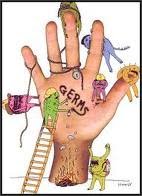
Do dirty hands signal a healthy imagination or are they a red flag for germs?


All kids are tactile learners.  They learn from physical contact with their environment as they explore the world around them.  My children are always finding exciting ways to get their hands DIRTY! 
I used to be one of those moms who was on team "Let a kid be a kid" and  "Don't worry if they eat a little dirt.  It'll strengthen their immune system"


As a health care provider, I have a small problem with this model of thinking.   As you're all well aware, most illnesses are passed through direct contact. Everyday we accumulate germs on our hands from a variety of sources, such as direct contact with people, contaminated surfaces, foods, even animals and animal waste.  The only way to rid yourself or your child of these germs is to wash the hands or use an alcohol rinse.


Awhile back I saw this video  The dirty truth about shopping carts  (must watch video to fully appreciate where I'm headed with this post) on the Today Show and I suddenly had a different perspective on purchasing one of these.                   
For example, Pearl is teething right now.  Let me explain what I mean by "teething".  This insane (but totally adorable) child throws a temper tantrum if I try to interfere with her chewing on human flesh, steal bars, the tires on the minivan (seriously, I found her hugging the back tire and chewing on it the other day).  I honestly think someone needs to invent a baby rawhide for teething babies. 
Last night at supper I handed her a cob of corn and she shredded that thing quicker than your curtains getting caught in the vaccum cleaner.  For a split second I actually contemplated letting her take the empty cob to bed with her as a form of pain relief since the pacifier wasn't cutting it anymore. 
After supper we took a trip to the store for some retail therapy.  I plopped Pearl in the shopping cart and immediately she bit down on the handle .  After a few slobbery seconds the Today Show video popped into my mind.  Yuck!!!! Gross!!   I  frantically grabbed the baby wipes and some hand sanitizer and started scrubbing the cart.

So what do you think?  Is this a form of hyper-parenting?  Do you wipe the carts before you use them or do you carry a cart cover with you?  Anyone have any novel ideas on how to protect my kids from the yucking germs found on public surfaces? I love these and carry them religiously in my diaper bag!  Would you ever purchase a disposable sleeve for your child to sneeze into or wipe their nose on?
Maybe you have a suggestion for what type of flavour would be best suited for my baby rawhide invention?  
If you have any thoughts on this subject then please drop me a line!

Monday, July 12, 2010

Medical Monday-Online Allergy Resources

Our poor little Opal suffers horribly from environmental allergies.  He is terribly allergic to grass, hay, horses, trees, cats and many detergents.  His immune response presents in the form of itchy, watery swollen eyes, wheezing and skin rashs. 
His triggers are mostly environmental however some children ( my niece included) suffer from severe even life threatening food related allergies. 

The allergy and immune response topic is quite complex so today I'm just going to scratch the surface by presenting you with some online resources.  If you would like me to write a more in-depth post on allergies than please comment or email me and I will gladly do so.

If you have a child who suffers from allergies than you may want to check out these great websites.

Opal really enjoys being apart of the Itchy Kids Club
We receive regular newsletters from the Itchy Kids Club
Another fun site is Kids Skin Health.  Did you know there are thousands of things to learn about the skin your in?  Learn about warts, pimples, birth marks, bug bites, skin cancers, and eczema.   It's a very cute, colorful and interactive site. 


Allergy Moms is another great online resource.  I really enjoyed reading their article "10 things children with food allergies want you to know".    While you are there you can sign up to receive their free email newsletters.

If your child has an allergy or a medical issue than it is vitally important they wear a medical identification product such as a bracelet or anklet.  I highly recommend you check out the Lauren's Hope site.  This site offers very fashionable medical alert products for children and adults.  The company also donates a portion of it's proceeds to jeuvenille diabetes.  Be sure to check out the very special history of thecompany and how it became "Lauren's Hope"

Mallergies is a great interactive site focusing on the latest trends and information on food allergies.
Check out some of their cute allergy apparel or read a few of their product reviews.

When it comes to tackling any health problem, knowledge is your most powerful tool. Educate yourself so that you can treat your child's allergies more effectively.

Do you have any information on allergies that you would like to share? Millions of children across Canada and the U.S. suffer from allergies. I would love to hear from you about this particular subject.


Monday, June 28, 2010

Oh My! I Think It's Pink Eye!

Out of the corner of your eye you notice your child fiercely rubbing his eyes.  Upon further inspection, you notice the whites of his eyes are no longer white.  They're red!!!  You ask yourself, "Is this Pink Eye?"


What is Pink Eye?
  • Conjunctivits is the medical term for "Pink Eye".  Conjunctivitis refers to an infection or inflammation of the conjunctiva (a membrane that coveres the white part of the eye. It's also found inside the eyelids).  It is typically a minor infection and the symptoms that accompany it are more bothersome than threatening to one's health.  


Bacterial Vs Viral
  • Bacterial Ccnjuncitivits is the most common cause of "Pink Eye".  It can be caused by different types of bacteria but the most common type is the H Influenzae bacteria.  Kids may also present with an ear infection when they have this type of bacterial eye infection.  Bacterial conjunctivitis is extremely itchy and produces green/yellow purulent drainage{almost pus-like).  Don't be alarmed if your child wakes in the morning with their eyelids practically glued shut because of the crusty drainage. 
  • Viral conjunctivitis usually produces a clear drainage.  Often kids will present with an accompanying sore throat, runny nose and cough.
  • Both bacterial and viral pink eye are contagious and spread easily through daycares, schools and playgroups. 
  • Bacterial pink eye is only contagious once the symptoms appear whereas viral conjunctivits can be contagious prior to the onset of any symptoms. 

How long is my child contagious?
It all depends on what causes of the inflammation/infection.  A child is not considered contagious if the inflammation is caused by allergies or irritiation from foreign matter.  For example,  Opal is extremely allergic to horses and he develops conjunctivits immediately after being in contact with them.  Other irritants may include: chlorine, soap and smoke. 
If the child has the bacterial or viral type then they are considered contagious while the eyes are still tearing{typically 3-7 days}.  However, most schools and daycares allow children to return after just 24 hours of being treated with antibiotics drops.

How does it spread? 
Pink eye spreads quite easily.  This is why so many educators and daycare providers fear it.  It is spread by touching the infected person or something the infected person has touched.  It can also be spread through droplets that are transported in the air when the infected person sneezes or coughs. 

How do you treat and prevent it?
Bacterial pink eye is typically treated with antibiotic eye drops or ointment. {Note- if the child is on oral antibiotics the physcian should be made aware of this.  In this case, optical eye drops may not be necessary}
Viral pink eye usually clears on it's own without treatment
Antihistamines are used to treat allergy related pink eye
Warm compresses to the eyes may comfort the child and help to clear the crusted drainage.
I also like to give Opal a funky pair of glasses to wear.  The glasses remind him not to rub his eyes. {Especially important if the pink eye is contained to one eye}

Note-If symptoms do not improve in 3-5 days or if the child complains of severe pain, changes in sight or sensitivy to light then it is important to contact your doctor.

Handwashing is the best way to prevent it from spreading.  Also, avoid sharing pillows and towels with an infected person. 


Has your child ever had pink eye?  I'd love to hear from you about it!  What helped comfort your child while dealing with the symptoms of pink eye?


Medical Disclaimer-The contents and information on this blog are for your informational use only. My blog posts provide general health and parenting information. This information in this blog is not intended to be a substitute for professional medical advice, diagnosis, or treatment. Always seek the advice of your physician or other qualified health provider with any questions you may have regarding a medical condition. Never disregard professional medical advice or delay in seeking it because of something you read on this blog.


Monday, June 21, 2010

Get The Scoop On Your Child's Poop-How to deal with your child's constipation

Medical Disclaimer-The contents and information on this blog are for your informational use only. My blog posts provide general health and parenting information. This information in this blog is not intended to be a substitute for professional medical advice, diagnosis, or treatment. Always seek the advice of your physician or other qualified health provider with any questions you may have regarding a medical condition. Never disregard professional medical advice or delay in seeking it because of something you read on this blog.


Warning:  This post talks about feces therefore it's best not to read while eating your breakfast. 

I've had many readers asking me to do a post on childhood constipation.  So, here it is!


I hate to admit, I'm one of "those" parents who's fixated on my child's poop. Yes, I said it!!! Not only do I examine my children's bowel movements, I also interpret my children's health from the COCA(color, odour, consistency and amount) of their poop.
My obsession with my kids' poop began when Sapphire and Opal started experiencing severe constipation problems.  I soon found myself documenting their bowel movements and consulting with our pediatrician about treatment options. { I told you I liked to journal}
Little did I know, that over the next several years I would become extremely schooled at not only changing diapers but also interpreting feces.

So, what's the real "Scoop on Poop"
This is a very brief overview of normal and abnormal bowel movements as well as treatment options for constipation.

We all remember the days of changing diapers. You may recall this colorOOOOOO or maybe it was closer to this*******.  Typically, all newborn bowel movements are described as seedy, yellow and liquid.
Each baby will develop their own pattern of pooping. Yes, it's true! Babies as young as newborns have a pooping patterns.  Some will poop 10-12x's/day, while others will poop every 2nd to 3rd day.
You may witness your newborn exhibiting forceful or strained bowel movements.  This is because the nerves in the lower rectum and anus are still maturing in newborns.  As long as the bowel movement is not solid your baby is NOT considered constipated. There is no need to be concerned with this type of  straining.  The organs of the digestive system are conducting the complex tasks of digesting and absorbing nutrients from the foods and liquids your baby consumes. The digestive organs of a newborn are extremely weak.  This is one of the reasons why it is so important to delay introducing solid food until  your baby is 4-6 months of age.
Once the child is introduced to solid food the COCA of their feces becomes extremely altered. At this point it is much more important to monitor the COCA of the stool.   It is crutial to observe the stools and well as the types of foods you introduced.  New foods can sometimes explain a sudden onset diaper rash.
It is also important to note that your child's feces will "firm up" when rice cereals or solid foods are introduced.  This is the stage that most babies experience their first bout of constipation.
Do you remember the days when you happened to find chunks of undigested peas or carrots in your child's diaper?  This happens for several reasons.  Mainly because young children are not experts in chewing  and therefore sometimes swallow pieces whole.  Add to this the fact that the digestive tract is still maturing and still lacking some of the "good bacteria" and enzymes necessary to break down food.
Usually around 12 months your child's feces will start to resemble the "classic" formed brown poop, much like that of an adult.


Now I'm going to discuss one of the most common Digestive Tract Problems in children.

Constipation

First I want to show you a little chart that is a very useful tool when discussing feces and constipation.{ Health professionals love charts because it gives them a guage or visual to compare incoming data}

This is a good tool to use when talking to your health care provider about your child's constipation issues


Constipation is defined as infrequent painful solid stools. Having had 2/3 child experience ongoing constipation, I sympathize with any parent who has witnessed a child pass "football" sized poops.
Trust me when I say we've tried it all.  Laxatives, diet restrictions, homeopathic remedies, probiotics and fish oils. You name it and we've tried it.
As you would expect, the most common cause of constipation in babies is a result of their diet!
Again, I want to point out that a baby's digestive system is still in the developing stages, therefore the introduction of constipating foods impact their ability to pass stools.  Foods to avoid if you find your baby passing painful solid stools include: bannanas, rice, applesauce and toast (known as the Brat Diet).  This includes rice pablum. 
Some excellent foods that promote soft stools include:  prunes, pears, spinach, beans, pumpkin and blueberries.   {I have a excellent spinach blueberry brownie recipe that my children love.  I fed it to them whenever they get a little bit constipated}
Dehydration is another common cause of constipation in children.  When children become sick with a fever or flu they often drink less and have greater water losses.   It is very important to promote fluid intake during times of sickness so that your child does not become constipated. 
The most common cause of constipation in older babies, toddlers and young children is "Withholding"
Unfortunately, it only takes a few painful bowel movements for a child to develop Encopresis aka "withholding of stools". Children are expert procrastinators and are great at ignoring the urge to pass stool. This allows them to hold their poop in for literally for days.  As a result their feces becomes firmer and firmer. When they do finally pass the stool it can be extremely painful for them--consequently creating a vicious cycle.
A child who continuely withholds poop can loose the sensation "to go" because the bowel becomes stretched and the muscles become weak.
Sapphire and Opal both suffered from Encopresis. Their bowels became completely blocked and liquid feces began to leak out around the solid stool. 
With the help of our pediatrician we were able to deal with the problem and overcome it.  Eventually, they grew out of this withholding stage.

Now this is probably the part that most of you are interested in.

Treatment options
  • Of course diet restrictions, increased fiber/fluid intake and exercise are the most natural remedies of constipation and the first line defense in prevention. 
Here is a good rule of thumb when it comes to fiber intake.  5 grams + your child's age.  Therefore, if your child is 2 years old than they should be consuming 7grams of fiber/day.  Yep, it's a lot but that's what it may take to prevent constipation in your little one.
  • If your child  is experiecing impaction  (how do you know if your child is impacted?  If you notice your child forcefully trying to pass stool but only passes or leaks liquid stool than chances are they may be impacted) than your child may need to start a "clean out" regime.  This should be done under guided supervision from a health care professional. A clean out process involves treating constipation orally and rectally to clear the entire contents of the large and small bowel.  Once the "clean out" process is complete it is critical to keep the stools very soft {almost mushy or pudding consistency} for quite sometime.  This allows the child to erase the memory of painful pooping and it improves muscle development in the bowel. Consider an athlete who trains at the gym each day to build their muscles.  It is important for the bowels to move daily in order to strengthen the muscles in the rectum and bowels.

  • Most laxatives and stool softners are available over the counter but it is very important to understand how these products work in the bowel before introducing them to your little one.   Some examples include:
Lactulose- This product is considered a stool softner.   
Lactulose is a sugar that is broken down in the small intestines.   It draws water into the bowel and ultimately into the stool, making it softer.  It comes in a syrup form and most children don't mind taking it because of it's sweet taste.  This is a good product for "withholders".  It is a maintenance product, meaning it should be taken regularly and may take up to 48 hours to soften stool.  It usually does not provide immediate results.  It should not be taken if the child is diabetic or on a low glucose diet because the main component of it is sugar.  Consult your doctor for appropriate dosing recommendations.  The one problem that I have found when my children took Lactulose is that the bowels may become somewhat dependant on the medication.  These may lead to increased dosing requirements


Pedialax- This product falls in the category of laxatives.  It is made of Senna-a natural vegetable based laxative that has been used for centuries.  It provides natural overnight relief. Typically working within 6-12 hours.  I prefer to treat with natural products than synthetic medications.  It has a grape flavour and dissolves instantly on the tongue.  This form is easier to take than the Sennekot tablets available.
Doseing:  For ages 2-5 :1 strip
                     ages 6-11:2 strips
If you can't find it on the shelves of your local drug store or health food store than you can ask a pharmacist to have it brought in for you.


Fiber Gummies-1.5 grams of fiber per gummie
This product is not a laxative but rather a supplement if you are having difficulty getting your child to consume the recommended daily dose of fiber


Miralax-This is a osmotic-type laxative.  In other words it draws water into the bowels and into the stool.  It also promotes more frequent stools.  I liked this product becasue it is easily incorporated into juice or food.  It can be provided in a colorless, odorless and tasteless crystal powder.  I appreciate the fact that I could give them medication without them knowing   Consult your health care provider for dosing


Enemas are not a pleasant experience for your child however sometimes they are a necessary part of a clean out regime.
It is important to lay the child on their left side with the knee up because this allows the solution to flow more easily into the bowels making it more effective.  It is also wise to administer the enema solution slightly warmed as to ease discomfort.
It typically provides instant relief of constipation. Usually after 3 minutes (So,be prepared for potential explosions)  


These are just a few of the many laxatives and stool softeners available on the market.  Please take time to learn about any medication you buy otc before you give it to your child.  As well, please consult a health care provider when giving your child any medication. 

I hope this post provided you with useful, up to date information on Constipation and Treatment Options. 
Feel free to contact me by leaving me a comment or emailing me if you have any more questions. 
If you have any suggestions on future medical posts than I'd love to hear from you. 
Again, this post is for information purposes only.  As a Registered Nurse, I am not authorized to diagnose but I do have an ethical obligation and passion to heatlh teach others about medial issues. 

Cheers


Monday, June 7, 2010

Medical Monday-Ear Infection Fact Sheet

Medical Disclaimer-The contents and information on this blog are for your informational use only. My blog posts provide general health and parenting information. The information in this blog is not intended to be a substitute for professional medical advice, diagnosis or treatment. Always seek the advice of your physician or other qualified health provider with any questions you may have regarding a medical condition. Never disregard professional medical advice or delay in seeking it because of something you read on this blog.


It's 2:00 am and you've been up all night with a screaming child who's trying to do back flips out of your arms.  You've been pacing the floors and your conversation with your loved one goes something like this:

Mom:  Take this kid for a second or I'm going to loose my mind.
Dad:  What do you want me to do with him?
Mom:  I don't know.  I'm not the doctor
Dad:  Well, then take him to emerg to see one
Mom:  Tonight?  Maybe it can wait until tommorow
Dad:  Whatever you think!
Mom:  I'm not sure either, what do you think?
{this conversation plays out for another 2 hours until finally someone packs the bags and off  you go to the local emergency room}

Ear infections are the #1 diagnosed childhood illness.  Affecting 90% of children before they ever hit school age.  As parents, we somehow become super detectives when our children are sick.  Looking for clues and trying to diagnose their illness.
The only thing most moms have to go by when reporting to a doctor is that their typically happy baby or child has suddenly become slightly "demon possessed"and they are seemingly no longer comforted by traditional means.  We've all had that same middle of the night experience when you ask yourself, is this teething or ears?
Unfortunately,  my kids have had countless ear infections which seems to be a somewhat inherited trait.  My husband has hearing loss as does his sister.  In fact, his sister has to wear hearing aids because of repeat ear infections as a kid. Opal has had 3 sets of tubes and Sapphire has had one. 

Today I put together a quick fact sheet to help everyone understand what Ear Infections are all about and what the possible treatment options are. 


What is Otis Media?
Otis Media is the medical term for a ear infection.
What are the two types of Ear Infections?
AOM(acute otitis media) This means that a part of the ear is infected and swollen.  Also known as a middle ear infection.
OEM(otitis media with effusion) This refers to the mucous or fluid that remains trapped in the ear after the infection has resolved.  Fluid and mucous can also accumulate because of the structure of the inner ear and because the eustachian tube does not drain the fluid properly.  Many children experience mild to moderate hearing loss as a result of fluid in the ear. Not only can it effect hearing but it also effects speech and language. 
What causes ear infections?
Ear infections are a direct result of viruses and/or bacterial entering the ear.  Ear infections also arise secondary to a previous cold or illness.
What is the eustchian tube and how does it contribute to ear infections?
When the ears are infected the eustachian tubes become inflamed and swollen. The adenoids can also become infected. The eustachian tubes are inside the ear. They keep air pressure stable in the ear. These tubes also help supply the ears with fresh air. The adenoids are located near the eustachian tubes. Adenoids are clumps of cells that fight infections.


Why do kids get so many ear infections and adults don't?
These tubes are smaller and straighter in children than they are in adults making it more difficult for fluid to drain out of the ear.
Most importantly, how do I know my child has AOM or OEM?
•Does she tug or pull at her ears?
•Does he cry more than usual?
•Do you see fluid draining out of her ears?
•Does he have trouble sleeping?
•Can she keep her balance?
•Does he have trouble hearing?
•Does she seem not to respond to quiet sounds?
Signs that fluid may be present in older children include delayed or difficulty with speech. 

Treatment Options

  1. Initially it is important to treat the pain associated with an ear infection.  OTC pain relievers such as Tylenol or Motril are recommended.  I tend to alternate between the two.   Tylenol is excellent in reducing a fever while Motrin has anti-inflammatory properties to reduce swelling within the ear.
  2. To treat with Antibiotics or not has always been the  unanswered question when discussing ear infections.  After discussing this with many family physicans the consensus is that the majority of children
  3. Surgery-Sometimes a surgery for the placement of small tubes ,lso known as a called a myringotomy is necessary to treat repeat or ongoing ear infections.  It has been performed since 1954 and is extremely safe. The tubes look like this][ and inserted through a very minute incision in the tympanic membrane(ear drum).  My two older kids have both had several sets of tubes.  The procedure took approximately 12 minutes start to finish and within 2 hours they were feeling mostly back to normal.  Expect the tubes to fall out within 6 months to a year as the ear canal grows.  Some children need a repeat myringotomy.  Another kind of surgery removes the adenoids. This is called an adenoidectomy. Removing the adenoids has been shown to help some children with otitis media who are between the ages of 4 and 8  Opal had his adenoids out with great results. If your child has 3 diagnosed ear infections in 6 months or 4 in 12 months then it may be time to consult a ENT(ears, nose and throat doctor).  Most refers are made through family physicians or nurse practitioners.
I also want to note that it is important children see a otiologist at least once to check their hearing prior to starting shool.  Undeteced hearing impariment can result in learning problems.

One final note on this topic of ears and ear infections.
Have you ever heard of the saying, "never put anything in a ear that's smaller than your elbow"?
Many parents feel the need to clear a child's ear canal of  the ear wax (aka cerumen).  Cerumen in the ear canal is actually a protective mechanism of the body.  It only becomes a problem when it prevents fluid in the ear from draining or if it prevents a health professional from visualizing the middle and inner ear components.  Most often ear wax falls out without any intervention.  Therefore, cue tips are best reserved for crafts and not for cleaning the ears.  By using cue tips you run the risk of pushing wax further into the ear canal which may result in ear wax impaction or even worse damage to the damage to the tympanic membrane the .  Ear wax impaction may require intervention.  To treat cerumen impaction you can place several drops of baby oil or olive oil in the affected ear to soften the wax so that it will be expelled by the body.  If this doesn't help than your Doctor may have to irrigate the ear or use a special instrument to remove the wax. To properly clean you child's ear you can wrap your finger around a warm wet cloth and wipe the outer ear.

I hope this helps with your questions and concerns in regards to ear infections.  Most importantly, trust your gut!  You know your child best!  Sometimes Doctors need to be reminded of this!

Do you have any other pediatric health questions that you would like me to answer or find the answers to?
Here are a few topics up for discussion.  Please let me know if you would like information on any of the following topics
  • infant and toddler constipation
  • allergies
  • rashes
  • vaccines
No health topic is off limits.  I will do my very best to provide you with the most accurate and up to date information on any health concern.